Thursday, June 28, 2007

El Turismo de Vino en Mendoza

(To read this post in English, click here)

La revista norteamericana Forbes escribe que la elite estadounidense ya no busca lugares tradicionales para las vacaciones como Londres, Paris, Roma, y Hawaii. ¿Dónde van los ricos ahora? ¡Argentina!

“En Argentina, la gente sabia satisface s
us deseos enófilos en Mendoza, una región fértil con bodegas que queda dos horas en avión de Buenos Aires. Con la atención internacional que recibe la Argentina sobre su vino y los hoteles lujosas como el Cavas Wine Lodge, que abrió en 2005, que ofrece alojamientos exclusivos, los viajadores concluyen que esta región vale la pena para visitar.”

Los que marcaron las tendencias de visitar la Argentina fueron los enófilos y los “sofistonautas” que ya conocía Napa, California y ya habían visitado a Francia y Italia. La combinación de la devaluación del peso en 2002 y la continuidad de la debilidad del dólar en comparación al euro creó la oportunidad de conocer una parte del mundo desconocido y una región vitivinícola nueva. Los empresarios en Mendoza respondieron a la demanda con alojamientos lujosos hechos para estos sofistonautas.

Muchas turistas de vino que viajan a Mendoza quieren pasar al menos una noche y un día en Buenos Aires. Recomiendo 1555 Malabia House, ubicado en el barrio Palermo Soho, que es muy fashion ahora. Mi hermano quedó allí el diciembre pasado y le encantó. El staff es muy amable, el chef hace lo que quiere para el desayuno cada mañana, se puede caminar a muchos restaurantes muy buenos, y las habitaciones son muy lindas. También, no es muy caro para lo que es – US$140 por una noche.

Si sos un enófilo, tal vez deberías alojarse en la Mansión Vitraux Hotel Boutique y Wine Lounge en el barrio San Telmo. No tengo expe
riencia personal allí, pero es relativamente nuevo y está en un barrio que está muy cerca de la Plaza de Mayo (Casa Rosada, Banco Central, Catedral, Ministerio de Economía, etc.) y Puerto Madero. También hay algunos restaurantes buenos en San Telmo y el mejor shopping de antigüedades en Buenos Aires.

También, he leído buenas criticas del Bobo (a la derecha), que está en Palermo como 1555 Malabia House.

Para las criticas de restaurantes de Buenos Aires, lea Guía Óleo y si lee ingles, hay un enorme lista de criticas en el blog de Dan Perlman, un dueño norteamericano de un restaurante en Buenos Aires.

Cuando llega a Mendoza después de un vuelo de dos horas desde Buenos Aires, tiene muchas opciones para el alojamiento lujoso. Probablemente el más lujosa afuera de la ciudad de Mendoza es el Cavas Wine Lodge. Pero si no quiere gastar US$300 por cada noche, no vayas a su sitio del web porque la tentación de hacer una reservación será muy fuerte. Hay una bodega en el lodge y las habitaciones tienen una vista hermosa de los Andes. Parece espectacular.

Un sitio bueno para buscar lugares para alojarse es BestOfMendoza.com. Este sitio es una colección de hoteles, bodegas, y restaurantes de primera categoría. No va a equivocarse con lugares que están en su sitio.

Para concluir, aquí es un resumen de algunos de los lugares de “Best of Mendoza.”

Hotel Piscis Las Leñas
Si te gusta esquiar y vivís en el hemisferio norte, ven en el Julio para disfrutarse en los Andes.

Estancia Rancho’e Cuero
Si querés ser un gaucho durante el día pero vivir en la modernidad, este estancia es para vos.

Bodega Salentein
Para los que quieren dormir al lado de la vid.

Park Hyatt Mendoza

Ubicado en la ciudad de Mendoza, no podés equivocarte en este hotel glamoroso (foto abajo).

Articulo: "Status-Symbol Trips." Por Shivani Vora. Forbes.com. 23 de mayo, 2007.

Wine Tourism in Mendoza

(Para leer esta nota en castellano, haga clic aquí)

Forbes Magazine claims that the “American elite” no longer are seeking to go to the traditional vacation spots (London, Paris, Rome, Hawaii). So where are they going now? Argentina!

“In Argentina, the cognoscenti indulge their oenophile instincts in Mendoza, a vineyard-rich region about two hours by plane from Buenos Aires. With Argentina's wine receiving international attention and luxury hotels like Cavas Wine Lodge, which opened in late 2005, offering upscale accommodations, travelers are finding this a worthwhile region to visit.”


The trend-setters were of course the oenophiles and “sophistonauts” who already knew Napa like the back of their hand and had been to France and Italy. The combination of the peso’s devaluation in 2002 and the dollar’s continued weakness in comparison to the euro has created the opportunity to get to know a new part of the world and a new wine region. Entrepreneurs in Mendoza have responded with more upscale accommodations tailored to the sophistonauts. The Forbes article mentions Cavas Wine Lodge, but I thought I’d mention a few others that offer a luxury experience.

Most wine tourists who travel to Mendoza want to spend a couple days in Buenos Aires. I can highly recommend 1555 Malabia House (pictured at the left), located in the trendy Palermo SoHo neighborhood. My brother stayed there last December and absolutely loved it. The staff is extremely friendly, breakfast is made to order every morning, it is within walking distance of a lot of great restaurants, and the rooms are very nice. It is also an excellent deal, with their smallest rooms going for US$140 a night.

If you’re an oenophile, you might want to try the Mansión Vitraux boutique hotel and wine lounge in San Telmo. I don’t have any personal experience with it, but its relatively new and is in a neighborhood that is within walking distance to the Plaza de Mayo (home to the Casa Rosada, the Central Bank, the Economic Ministry, the original town hall, etc). There are also some good restaurants in San Telmo and the best antique shopping in Buenos Aires.

One other boutique hotel I’ve heard good things about is Bobo, which, like 1555 Malabia House, is in Palermo.

For the most comprehensive English-language restaurant reviews in Buenos Aires, check out Dan Perlman’s Saltshaker blog. In addition to running one of the new family-style, closed-door restaurants, he is also a sommelier, which is evident in his reviews.

Once you get to Mendoza after the two hour flight, you have a number of options. The most luxurious is the aforementioned Cavas Wine Lodge (pictured at the right). If you aren’t willing to spend 300 dollars a night for a double, don’t go to their website because you will be tempted to make a reservation. There is a vineyard on site and rooms overlook the Andes. It looks spectacular.

A good website to check out is BestOfMendoza.com. This is a collection of high-end hotels, wineries, and restaurants that have formed a loose alliance. You can’t go wrong with any of the places that are listed there.

To conclude, here's a quick rundown of some of the "Best Of Mendoza":

Hotel Piscis Las Lenas
If you are a ski bum, come here in July to carve the southern hemisphere snow.

Estancia Rancho’e Cuero
If you want to feel like a gaucho during the day and be pampered at night, this ranch is for you.

Bodega Salentein
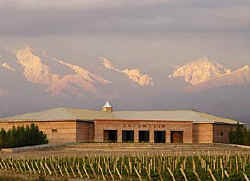
For those who want to sleep with the vines (pictured at the right).

Park Hyatt Mendoza

Located in the city of Mendoza, you can’t go wrong with this beautiful hotel.


Article: "Status-Symbol Trips." By Shivani Vora. Forbes.com. May 23, 2007.
Image 1: 1555 Malabia House.
Image 2: Cavas Wine Lodge.
Image 3: Bodega Salentein.

Wednesday, June 27, 2007

News Wrap-Up

(Para leer esta nota en castellano, haga clic aquí)

In the San Marcos Daily Record (San Marcos, Texas), the “wine guys” – Tom Marquardt and Patrick Darr – detail the recent success of Argentine wine, and more specifically, Malbec.

“Winemakers in Argentina getting some attention.” By Tom Marquardt and Patrick Darr. San Marcos Daily Record. June 27, 2007.

New York Sun (New York, NY) wine writer Matt Kramer recommends the Punto Final Malbec 2006 Bodega Renacer, suggesting that Bodega Renacer skillfully combines vines that are at least 50 years old with modern wine making techniques.

“Wines for the Obsessive Mind.” By Matt Kramer. New York Sun. June 27, 2007.

In the Wall Street Journal’s weekly Q&A column on wine, a reader asks which kind of wine she should introduce her husband to if he isn't a wine drinker. The answer? “Try a Chardonnay from Chile or Argentina. The labels are as easy as the wines and they're inexpensive, so there's no pressure.”

“Wine Notes.” By Dorothy Gaiter and John Brecher. Wall Street Journal. June 23, 2007. (subscription required)

Dave McIntyre discusses wines appropriate for the summertime on Washingtonian.com. He suggests the Santa Julia Torrontés 2006. He says, “…no winery hits the value/quality quotient quite like Santa Julia, a winery known for value in all its wines.”

“Two Bargain Whites for Summer.” By Dave McIntyre. Washingtonian.com. June 21, 2007.

Vinexpo is the world’s largest wine fair, held yearly in Bordeaux. A big theme of this year was how the old world wine countries were falling behind the new world in terms of marketing. The article, from Reuters News Service, says, “New wine producers Chile and Argentina are up one end of the main hall. Their stands are buzzing with potential buyers who are swilling away on the wine that is sold in bottles with minimalist labels, catchy names and amusing pictures…That contrasts with many of the French labels that have stuck to traditional designs, give information on the chateau, details lost on the average Saturday night drinker.”

“Old wine in new bottles – a French revolution.” By Unknown. Reuters News Service. June 21, 2007.

Un resumen de las noticias de vino argentino

(To read this article in English, click here)

En el San Marcos Daily Record (San Marcos, Texas, EE.UU.), los “hombres de vino” – Tom Marquardt and Patrick Darr – escriben sobre el éxito reciente del vino argentino, y mas específicamente, el Malbec.

“Winemakers in Argentina getting some attention.” Por Tom Marquardt and Patrick Darr. San Marcos Daily Record. 27 de junio, 2007.

El periodista de vino Matt Kramer recomienda en el New York Sun (La ciudad de Nueva York) el Punto Final Malbec 2006 Bodega Renacer, sugiriendo que la Bodega Renacer combina las viñas que tienen mas de cincuenta años y las técnicas modernas para hacer vino.

“Wines for the Obsessive Mind.” Por Matt Kramer. New York Sun. 27 de junio, 2007.

En el artículo semanal de preguntas y respuestas sobre vino en el Wall Street Journal (EE.UU.), un lector femenino pregunta que tipo de vino debería ofrecer a su esposo que no le gusta el vino. La respuesta es un Chardonnay de Chile o Argentina. Escriben, “Las etiquetas son tan fáciles que los vinos y son baratos, así que no hay presura.”

“Wine Notes.” Por Dorothy Gaiter and John Brecher. Wall Street Journal. 23 de junio, 2007. (exige un subscripcion para leer)

Dave McIntyre del Washingtonian (Washington, DC) escribe sobre los vinos que son apropiados para el verano. Sugiere el Santa Julia Torrontés 2006. Dice, “…no hay una bodega que tiene la relación de precio a calidad como Santa Julia, una bodega que tiene una reputación por su valor en sus vinos.”

“Two Bargain Whites for Summer.” Por Dave McIntyre. Washingtonian.com. 21 de junio, 2007.

Ubicado en Francia, Vinexpo es la feria de vino más grande del mundo. Un tema importante de este año fue la caída de la calidad de marketing en el viejo mundo en comparación a los países del nuevo mundo. El articulo, de Reuters, un servicio de noticias norteamericana, dice, “Los nuevos productores como el Chile y la Argentina están ubicados en un lado del pasillo. Sus stands estaban llenos con compradores potenciales que estaban tomando vinos vendidos en botellas con etiquetas minimalistas, nombres pegadizos y fotos comicas…Este escenario contrae a las etiquetas franceses que siguen con disenos tradicionales, ofrece información sobre el chateau, que son detalles que no le importa el consumidor promedio de vino.”

“Old wine in new bottles – a French revolution.” Por un autor no conocido. Reuters News Service. 21 de junio, 2007.

Growing Wine Industry Threatens Native Argentines

(Para leer este articulo en castellano, haga clic aquí)

The growth of the Argentine wine industry has been thoroughly covered on Argenvino. However, the consequences of such growth have not been detailed as rigorously. A recent National Geographic article describes the plight of the Huarpe people living in the Monte Desert. Due to the increased use of upstream water supply by grape growers, researchers have concluded that the Huarpe may begin to receive less and less water in their already dry location.

At the turn of the twentieth century the massive Italian and Spanish migration forced the Huarpe – which are also know as Lavallinos – to find land elsewhere. Instead of going to cities, they went to the Monte Desert, a place nobody was willing to go to. They now rely on the Mendoza River, which is fed by melting snow from the Andes. However, as the wine industry continues to grow, more grape growers are using the water.

The research that has concluded that the water tables are diminishing has been completed by agronomist Esteban Jobbagy of the National University of San Luis and colleagues at Duke’s Nicholas School of the Environment and Earth Sciences.

For Jobbagy, the solution lies in how vineyards irrigate. Most vineyards still use the mantle irrigation system, which includes flooding the vines every month or so. He claims that using the more advanced (and expensive) drip irrigation technique, which uses small pipes to feed the vines slowly, would help solve the problem.

Unfortunately, this is an issue that may fall on deaf ears. The wine business is a multi-billion dollar industry, while the Huarpe Indians only number in the few hundreds and have virtually no financial resources.

Source: “Wine Boom Threatens Native Argentine Water Source.” By Lorne Matalon. National Geographic News. June 20, 2007.

Image Location: National Geographic News Photo Gallery. Picture is of agronomist Esteban Jobbagy (National University of San Luis).

La industria de vino amenaza la fuente de agua para los indios

(To read this article in English, click here)

El crecimiento de la industria vitivinícola en la Argentina ha sido discutido mucho en Argenvino. Sin embargo, las consecuencias de este crecimiento no ha sido detallado tan rigurosamente. Un artículo reciente en la revista norteamericana, National Geographic describe la situación apremiante de los indios Huarpe que vive en el Desierto Monte. Debido al uso, describe la situación incrementado del agua del Río Mendoza de las bodegas, el Huarpe recibe menos agua en su lugar que ya sufre en un lugar seca.

A los principios del siglo veinte las olas de inmigrantes italianos y españoles causaron el Huarpe para mudarse de la Pampa al desierto. Ahora ellos dependieron en el Río Mendoza, que lleva agua desde los Andes. Sin embargo, mientras que la industria vitivinícola continúa crecer, más campesinos de uvas usan el agua y hay menos agua para el Huarpe que queda más de 100 kilómetros afuera de la zona vitivinícola.

La investigación que concluyó que el nivel del agua freática está disminuyendo fue hecho por el ingeniero agrónomo Esteban Jobbagy de la Universidad Nacional de San Luis y sus colegas en Duke University (EE.UU.).

Jobbagy cree que la respuesta al problema es un cambio del tipo de sistemas de irrigación. Muchas bodegas irrigan las viñas con una masiva concentración de agua una vez cada mes. Jobbagy sostiene que el uso del sistema más avanzado (y caro) – la irrigación que usa gotas de agua que va a cada planta – podría resolver el problema.

Desgraciadamente, este es un tema que puede caer en saco roto. El negocio de vino es una industria multi-mil millonaria mientras que los indios Huarpe solo consisten de cientos de habitantes y no tienen recursos financiarías.

Fuente: “Wine Boom Threatens Native Argentine Water Source.” Por Lorne Matalon. National Geographic News. 20 de junio, 2007.

Lugar de las imágenes: National Geographic News Photo Gallery.

Tuesday, June 26, 2007

Argentine Beer Is More Than Just Quilmes

(La versión en castellano puede estar leída acá)

As you probably already know, this is a blog about Argentine wine. However, this morning I stumbled upon an Argentine beer gaining some attention here in the U.S. First of all, Argentina would never be mistaken for Germany or Belgium for its beer quality and variety. While supermarkets dedicate entire aisles to wine, you would be lucky to find more than four or five kinds of beer. Quilmes, Stella Artois, Brahma, Heineken, and Budweiser dominate the market. And, although I truly do love Quilmes for its memory-inducing qualities of life in Buenos Aires, I am the first to admit that it’s not exactly the best beer in the world.

It seems that Quilmes, contrary to what many Argentines think, isn’t even the best domestic beer in Argentina (side note: the Buller Brewing Company in Buenos Aires has some very tasty beers, albeit pricey if you make money in pesos). One domestic beer critics are raving about is the Jerome Handcrafted Beer from Potrerillos, Mendoza.

My first reaction was, “Potrerillos?!?!” I haven’t explored many places outside of the city of Mendoza, but Potrerillos is one place I feel like I know very well, having visited three different times to go mountain biking and rafting (The picture at the right is of me, in 2005, in the bustling metropolis of Potrerillos). The town only has a few hundred residents (a guide at Argentina Rafting told me this) and is situated in what they call the “pre-cordillera” which translates to the “pre-mountain range” of the Andes. It is very dry, but the glacier-fed river (pictured below in 2005) that runs alongside the town is spectacular. This pure water provides the brewery with natural, healthy water that is not contaminated by chlorine found in city water supplies.

Jerome is a relatively new brewery, having been started in 1999, and currently employs only four people. The fascinating story of how the brewery came to be is explained by brewer Eduardo Maccari:

"It all started in the eighties, when I met a couple of Czechs that would change the course of my destiny. One winter afternoon, I was told that one of my Czech friends had gone to climb "El Plata", one of the highest peaks in the Andes and he hadn't returned. Fearing that an accident had occurred, I rushed to get help at the Air Force Base. They kindly took me to the site, where we spotted our friend's tent. There he was lying, asleep, frozen. We thought he had died, in fact, he showed no vital signs. We took him to the city of Mendoza, where, after a long time, he miraculously recuperated. In recognition, I was later invited to travel to the Czech Republic, where an old brewer taught me the art of beer making with an old recipe. Now I reproduce that recipe for you. This is how our brewery started. I started making beer as a hobby, in silence. Then I shared it with my friends, and now I'm brewing beer for the rest of Argentina and a few states in the USA, hoping you will enjoy drinking it as much as I do when I make it."

There aren’t many better stories than Eduardo’s. The operation still remains small, with Jerome only making five barrels a day. Those kinds of numbers would make one think that this is a part-time operation in someone’s basement. Not so. The Southern Wine Group, which imports to the United States well-known wineries such as Enrique Foster, snatched up the importing rights and is now distributing Jerome to several states in the U.S.

Currently, Jerome offers four flavors: Rubia, a light ale, Roja, a red ale, Diablo, a strong ale and Negra, a dark ale. You can read their tasting notes in a PDF here. According to this article on a beer website, the famed BBC wine critic Oz Clark came to Mendoza with the idea of tasting many of the fine wines from the region. After trying Jerome at the Hyatt Hotel in Mendoza, Clark raved about the beer and returned to London with his accolades. Weeks afterwards, Jerome had an order request of a 1,000 bottles from the Gaucho Grill, an Argentine-style steakhouse chain in the U.K.

If you are reading from the U.S., you can email Info@SouthernWineGroup.com to find out if Jerome is sold in your area or buy Jerome directly online here. If you are reading in Argentina, you can consult Jerome's list of places it is sold here.

Sources:

Images copied from the Jerome Brewery website and the Southern Wine Group website.

Article: “Cerveza with a sense of place.” By Gary Corbin. Guestontap.com. Accessed on June 26, 2007.